Teach the importance of financial autonomy
Help women in shelters and young people leaving care (foster homes, orphanages) who have little other support open a bank account, keep control of it, and use it with confidence.
Co-developed with financial literacy experts and social entrepreneurs.
Meet Isha
Isha has worked as a maid for the same family for two years. She is paid in cash. When she gets home, the cash goes into the hands of her husband, her father or another relative.
She has no bank account in her name, and she does not know how much she has earned. She does not know what a fixed deposit is or how to start saving. Her goals are simple: a scooter to get to work, a Diwali present for her mother. She does not know she can open a Jan Dhan account for free.
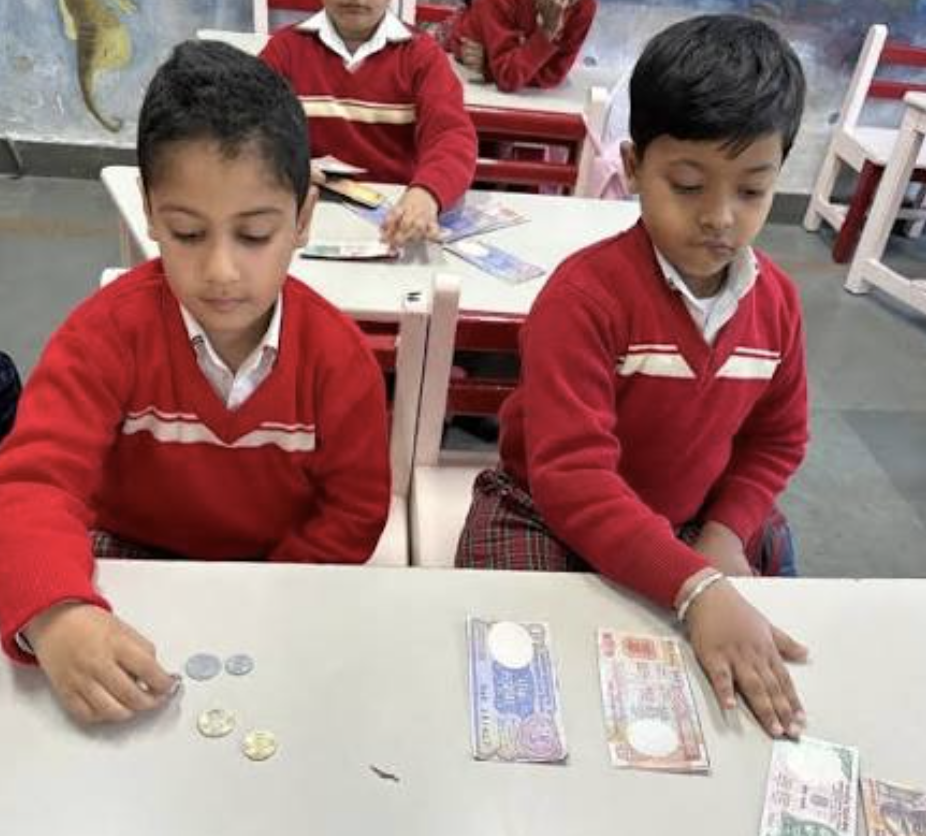
Over a few sessions, an Udayaa changemaker can get to know her, show her the financial tools open to her, and get her a working bank account in her own name, linked to her Aadhaar and her own phone number. Then they practise using it together, until Isha has real control over the money she earns.
Isha is a composite example, not one person's story.
Why this project
About 89% of Indian adults now have a financial account.1 Worldwide, 1.3 billion adults still have none,2 and about 700 million of them are women.3
Pradhan Mantri Jan Dhan Yojana (PMJDY) was launched in August 2014 as the National Mission for Financial Inclusion, with the aim of at least one basic bank account for every household, plus financial literacy and social security cover.4 By 12 August 2026 there were 59.04 crore Jan Dhan accounts, and 15.37 crore of them, about 26%, were inoperative.5 An account becomes inoperative when its owner makes no transaction for two years.6 In India, 16% of account owners do not have an active account, against an average of 4% in other low and middle income economies.7
Only 27% of Indian adults were financially literate in the 2019 national survey by the National Centre for Financial Education (NCFE).8 By 2023 to 2024, 89.0% of women said they had a bank or savings account they used themselves.9 That still leaves about one woman in ten without one, and the gap is much wider in some states.
Where women are least likely to have an account they use themselves
Tap a state to see its numbers. The key shows the share of women without one.
Tap or select a state.
India: 21.4% of women had no account they used themselves in 2019 to 2021.
Map: share of women aged 15 to 49 without a bank or savings account they use themselves, NFHS-5 (2019 to 2021).10 Jan Dhan figures in the panel are as of 12 August 2026, published only for a few large states.5 Jammu and Kashmir and Ladakh share one shape in this boundary file, and the panel shows both. State outlines from the DataMeet India states file, simplified for display.
See every state as a table
| State or UT | Women with own account | Without | Jan Dhan, Aug 2026 |
|---|---|---|---|
| Nagaland | 63.7% | 36.3% | Not reported |
| Lakshadweep | 66.9% | 33.1% | Not reported |
| Gujarat | 70.0% | 30.0% | Not reported |
| Meghalaya | 70.4% | 29.6% | Not reported |
| Delhi | 72.5% | 27.5% | Not reported |
| Maharashtra | 72.8% | 27.2% | 97.94 lakh inoperative of 3.85 crore (25.4%) |
| Haryana | 73.6% | 26.4% | Not reported |
| Manipur | 74.0% | 26.0% | Not reported |
| Madhya Pradesh | 74.7% | 25.3% | 1.35 crore inoperative |
| Uttar Pradesh | 75.4% | 24.6% | 3.23 crore inoperative of 10.51 crore (30.7%) |
| Sikkim | 76.4% | 23.6% | Not reported |
| West Bengal | 76.5% | 23.5% | 1.02 crore inoperative of 5.73 crore (17.8%) |
| Bihar | 76.7% | 23.3% | 1.59 crore inoperative of 7.01 crore (22.7%) |
| Tripura | 76.9% | 23.1% | Not reported |
| Arunachal Pradesh | 78.2% | 21.8% | Not reported |
| Assam | 78.5% | 21.5% | Not reported |
| Kerala | 78.5% | 21.5% | Not reported |
| Jharkhand | 79.6% | 20.4% | Not reported |
| Rajasthan | 79.6% | 20.4% | of 3.87 crore |
| Uttarakhand | 80.2% | 19.8% | Not reported |
| Chhattisgarh | 80.3% | 19.7% | Not reported |
| Mizoram | 80.7% | 19.3% | Not reported |
| Punjab | 81.6% | 18.4% | Not reported |
| Andhra Pradesh | 81.8% | 18.2% | Not reported |
| Himachal Pradesh | 83.1% | 16.9% | Not reported |
| Dadra & Nagar Haveli and Daman & Diu | 83.6% | 16.4% | Not reported |
| Telangana | 84.4% | 15.6% | Not reported |
| Jammu & Kashmir | 84.9% | 15.1% | Not reported |
| Odisha | 86.5% | 13.5% | Not reported |
| Chandigarh | 87.1% | 12.9% | Not reported |
| Goa | 88.3% | 11.7% | Not reported |
| Ladakh | 88.4% | 11.6% | Not reported |
| Karnataka | 88.7% | 11.3% | Not reported |
| Andaman & Nicobar Islands | 89.2% | 10.8% | Not reported |
| Tamil Nadu | 92.2% | 7.8% | Not reported |
| Puducherry | 92.6% | 7.4% | Not reported |
What the research says
The evidence is mixed, and the design of this playbook follows from it.
Free accounts alone change little
Null resultA trial in Uganda, Malawi and Chile offered people free basic accounts. Over two years only 17%, 10% and 3% of them made five or more deposits, and the study found no clear effect on savings.11
A small cash incentive did more than a class
MixedIn Indonesia, a financial education session raised account opening only among people with little schooling or low financial literacy. Small subsidies of US$3 to US$14 raised it sharply, and those accounts were still in use two years later.12
Teaching does work on average
PositiveA review of 76 randomised trials with over 160,000 people found that financial education improves both knowledge and behaviour such as saving, by amounts similar to other education programmes.13
Control over her own money matters most
Positive, IndiaIn rural Madhya Pradesh, women who got their own account, training in using it and their public works wages paid straight into it worked more than women given an account alone. Three years later their views on women working had shifted too.14
So this playbook pairs teaching with a funded first deposit, a savings match, a working phone number and PIN under the participant's control, and six months of follow-up.
Who it serves
Women in shelters
AdultsSakhi One Stop Centres give women affected by violence temporary shelter alongside medical, legal and counselling help.15 Shakti Sadan homes, which replaced Swadhar Greh and Ujjawala homes under Mission Shakti, offer longer stays.16 Some residents arrive without ID, or with an account someone else controls.
Care leavers
Ages 18 to 21Young people leaving foster homes and orphanages can receive aftercare support of Rs 4,000 a month under Mission Vatsalya.17 They need a working account and money skills straight away.
Women in informal work
In your communityDomestic helpers and cooks in gated communities, street vendors, home-based tailors, construction and daily-wage workers. Many are paid in cash with no record of what they earn. You can run sessions in your own neighbourhood, for example through your residents' welfare association.
Other adult groups
Through a partnerWomen's self-help groups, domestic workers' collectives or a partner NGO's adult programme can run the same plan.
Start with one site and 25 to 30 people. Taking part is always voluntary, and shelter staff decide who can safely join.
An earlier version included Classes VI to X and children's homes. Children rarely have money of their own to save or manage, so the account and deposit parts add little for them. A school version would use only Layer 1 below, with no accounts.
What to teach
The programme is six sessions of 60 to 90 minutes. They are grouped into three layers, and each layer builds on the one before: first keeping money safe, then using the account, then planning ahead.
Safety and control
Sessions 1 and 2
- Who controls your money
- Your PIN, passbook and SIM
- Warning signs of control
- Fraud and the 1930 helpline18
Using your account
Sessions 3 and 4
- Needs and wants
- Passbook, ATM and UPI
- Reactivating an account
Planning ahead
Sessions 5 and 6
- Saving goals
- Fixed and recurring deposits
- Moneylenders and scams
- Insurance and schemes
Resources
NCFE Financial Education Programme for Adults
FreeFree workshops and material on budgeting, saving, banking, borrowing, digital payments, insurance, schemes and fraud.19
Open FEPAFirst Rupee and Co comics
Udayaa changemakerComic books on financial agency by Shreya Sandurkar, drawn by young local artists. They follow a girl as she grows up, starting with borrowing and lending between friends, and are written for girls aged about 9 to 12.
Read Shreya's storyMoney Bhai
Free gameA virtual trading game by Moneycontrol. Players get Rs 1 crore of pretend money to put into shares, mutual funds and fixed deposits using real market data.20 Useful for seeing that shares can fall as well as rise.
Open Money BhaiBudget
If you run this project, the budget below covers 30 participants. Most of the money goes into participants' own accounts as a Rs 500 first deposit and a savings match of up to Rs 250 over three months.
| Line item (30 participants) | Rs |
|---|---|
| Seed deposits (30 × Rs 500) | 15,000 |
| Savings match (30 × up to Rs 250) | 7,500 |
| Savings pouch and printed workbook (30 × Rs 150) estimate, get a local quote | 4,500 |
| Snacks (30 × 6 sessions × Rs 20) estimate, get a local quote | 3,600 |
| Photos and document copies (30 × Rs 50) estimate, get a local quote | 1,500 |
| Travel for bank visits and follow-ups estimate, get a local quote | 3,000 |
| Contingency (10%) | 3,510 |
| Total | Rs 38,610 |
Where the money goes
Computed from the budget table above.
If someone saves less than Rs 250, the unused match stays in the campaign. Tell donors up front that it funds the next cohort.
Suggested campaign goal: Rs 38,610 for 30 participants. For a smaller or larger cohort, use Rs 26,840 for 20 or Rs 50,380 for 40. Travel stays the same at any size.
How to measure it
| Measure | When |
|---|---|
| Headline: share who made at least one deposit or withdrawal themselves | 3 and 6 months after |
| Accounts working ÷ people enrolled | After the sessions |
| Holds own passbook, card, PIN and linked phone (yes or no) | Before and after |
| Quiz score, before and after | Before and after |
| Can name three fraud warning signs | After the sessions |
| Average own savings, excluding seed and match | 6 months after |
Report participants' own deposits separately from the seed and match, so donors can see how much participants saved by themselves.
Who has done this
Researchers with government partners, Madhya Pradesh
Randomised trialGave rural women their own accounts, training in account use and direct deposit of their wages. Women who got all three worked more than women given only an account.14
RBI Centres for Financial Literacy
Government2,421 centres covering 7,225 blocks by March 2024, running free camps with NGOs and sponsor banks.21 A student project can plug into one.
Shreya Sandurkar, First Rupee and Co
Udayaa changemakerUses comics drawn by young local artists to teach financial agency to girls in low-income government schools. Read her spotlight.
No Udayaa campaign has run this exact version yet. The first cohort's results will go here.
Who built this playbook
Changemaker
Shreya SandurkarFounder of First Rupee and Co, co-developing the teaching approach.
Advisor
Vivek GangaadarFinancial literacy advisor reviewing the content. [Confirm title and how he would like to be credited.]
Community partner, India
In discussionSHINE, an NGO Udayaa is reaching out to, to confirm the plan fits the people it serves.
Organizational partner
To be confirmedAn NGO with a track record in financial literacy, or a university social impact programme, to check the approach.
Run this in your city
- Pick one group near you: a shelter, an aftercare programme, or women who work as helpers in your own neighbourhood.
- Look up the nearest Centre for Financial Literacy on the RBI financial education site.
- Tell Udayaa your site and cohort size. We will help you set the goal, check the fund flow and launch your page.
Sources
- Press Information Bureau, "Financial Inclusion in India," factsheet, accessed November 10, 2026, https://pib.gov.in/FactsheetDetails.aspx?Id=150832. Cites the World Bank Global Findex 2025.
- World Bank, "The Global Findex Database 2025," via Financial Inclusion Gateway (CGAP), accessed November 10, 2026, https://www.findevgateway.org/data/global-findex-database.
- World Bank, "More Women Have Financial Accounts, Yet Equal Access and Use Remain Works in Progress," Data Blog, accessed November 10, 2026, https://blogs.worldbank.org/en/opendata/more-women-have-financial-accounts--yet-equal-access-and-use-rem. The 700 million figure covers low and middle income economies.
- Press Trust of India, "Over 15 Cr PM Jan Dhan Accounts Classified as Inoperative: RTI," Nagaland Post, September 6, 2026, https://nagalandpost.com/over-15-cr-pm-jan-dhan-accounts-classified-as-inoperative-rti/.
- Tribune News Service, "Of 59 Cr Jan Dhan Accounts, 5.72 Cr at Zero Balance, Every 4th Inactive," The Tribune, September 2026, https://www.tribuneindia.com/news/top-headlines/of-59-cr-jan-dhan-accounts-5-72-cr-at-zero-balance-every-4th-inactive/. Reports a Ministry of Finance RTI reply with data as of August 12, 2026.
- Press Trust of India, "113 Mn Inoperative Jan Dhan Accounts Hold Rs 14,750 Cr as of Nov 20: Govt," Business Standard, December 10, 2024, https://www.business-standard.com/industry/banking/113-mn-inoperative-jan-dhan-accounts-hold-rs-14-750-cr-as-of-nov-20-govt-124121000874_1.html.
- World Bank, The Global Findex 2025: Figure List, figure S3.1.1, https://thedocs.worldbank.org/en/doc/be6615202d1f08a25855c8ac2d615122-0050012025/related/Global-Findex-2025-figure-list.pdf.
- Samim Aktar Molla and Soumyadwip Das, "Financial Literacy in India: Insights from National Financial Literacy and Inclusion Survey (NCFE-FLIS) 2019 Report," International Journal of Commerce and Management Research 10, no. 6 (2024): 63–68, https://www.managejournal.com/archives/2024/vol10/issue6/10139.
- Ministry of Health and Family Welfare, "Union Health Ministry Releases National Family Health Survey-6," press release, Press Information Bureau, May 29, 2026, https://www.pib.gov.in/PressReleasePage.aspx?PRID=2266600.
- International Institute for Population Sciences and Ministry of Health and Family Welfare, National Family Health Survey (NFHS-5), 2019-21: Compendium of Fact Sheets, India and States/UTs, Phase I and Phase II (Mumbai: IIPS), indicator 122, Phase I and Phase II. State values taken from Pratap Vardhan's machine-readable NFHS-5 dataset, https://github.com/pratapvardhan/NFHS-5, and spot-checked against the compendium.
- Pascaline Dupas, Dean Karlan, Jonathan Robinson, and Diego Ubfal, "Banking the Unbanked? Evidence from Three Countries," American Economic Journal: Applied Economics 10, no. 2 (2018): 257–97, https://doi.org/10.1257/app.20160597.
- Shawn Cole, Thomas Sampson, and Bilal Zia, "Prices or Knowledge? What Drives Demand for Financial Services in Emerging Markets?," Journal of Finance 66, no. 6 (2011): 1933–67, https://doi.org/10.1111/j.1540-6261.2011.01696.x.
- Tim Kaiser, Annamaria Lusardi, Lukas Menkhoff, and Carly Urban, "Financial Education Affects Financial Knowledge and Downstream Behaviors," Journal of Financial Economics 145, no. 2 (2022): 255–72, https://doi.org/10.1016/j.jfineco.2021.09.022.
- Erica Field, Rohini Pande, Natalia Rigol, Simone Schaner, and Charity Troyer Moore, "On Her Own Account: How Strengthening Women's Financial Control Impacts Labor Supply and Gender Norms," American Economic Review 111, no. 7 (2021): 2342–75, https://doi.org/10.1257/aer.20200705.
- Department of Women and Child Development, Government of NCT of Delhi, "Mission Shakti," accessed November 10, 2026, https://wcd.delhi.gov.in/sites/default/files/WCD/generic_multiple_files/mission_shakti.pdf.
- Ministry of Women and Child Development, "FAQs," accessed November 10, 2026, https://wcd.nic.in/faqs.
- Ministry of Women and Child Development, Mission Vatsalya Implementation Guidelines (New Delhi: Government of India), accessed November 3, 2026, https://cara.wcd.gov.in/pdf/Mission%20Vatsalya%20Guideline.pdf.
- Kerala Police, "National Cyber Crime Reporting Helpline No 1930," accessed November 10, 2026, https://ps.keralapolice.gov.in/ernakulamruralcyber-ps/notifications/National-Cyber-Crime-Reporting-Helpline-No-1930-3338.
- National Centre for Financial Education, "Financial Education Programme for Adults (FEPA)," accessed November 3, 2026, https://ncfe.org.in/fepa/.
- MediaInfoline, "Moneycontrol Brings India's Biggest Virtual Trading Game: Moneybhai," November 13, 2019, https://www.mediainfoline.com/advertising/moneycontrol-brings-indias-biggest-virtual-trading-game-moneybhai.
- Reserve Bank of India, "Credit Delivery and Financial Inclusion," chap. 4 in Annual Report 2023-24 (Mumbai: RBI, 2024), https://website.rbi.org.in/documents/87730/109104173/Chap+4+An+23-24.pdf.