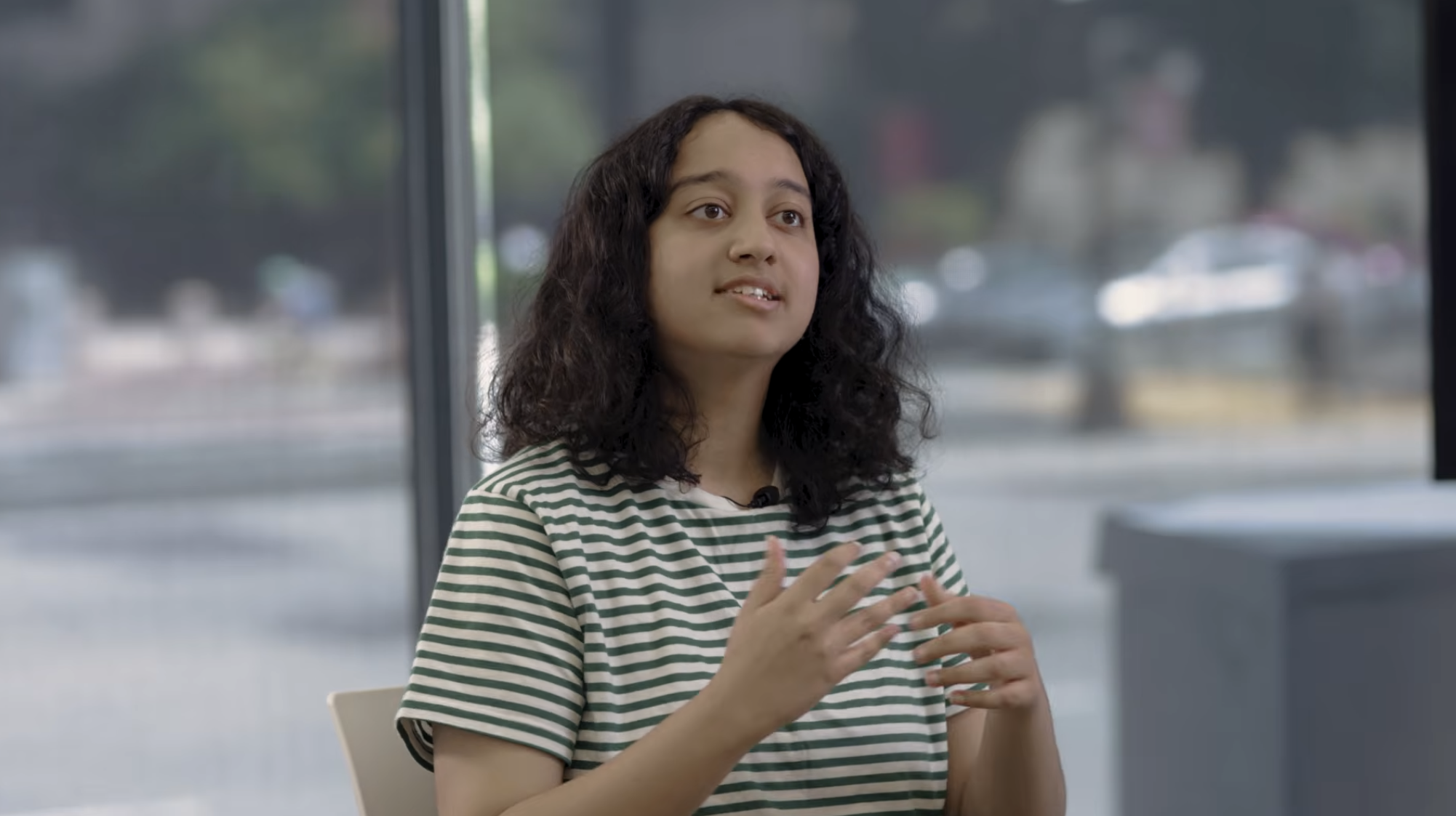
Growing up in Pune, Shreya Sandurkar noticed a split among the people around her. Some made their own decisions about money and carried themselves differently because of it. Others had never been given that choice. The gap she saw had less to do with access to information and more to do with who that information was written for.
Today Shreya is a graduate student at Boston University's Questrom School of Business, studying mathematical finance and financial technology after an undergraduate degree in engineering at Ohio State. She is also the founder of First Rupee and Co., a venture that writes comic books on financial agency for girls aged about 9 to 12 in low-income government schools.
Two barriers nobody designs for
Why a comic book
Shreya's reasoning comes from how memory works. A pamphlet gets forgotten. A character stays with you, and when a girl later faces a real decision, she can recall how that character handled it.
“People can remember stories if not direct resources given to them.”
Shreya Sandurkar, speaking to Innovate@BUShe points to the comics many Indian children grew up on, like Tinkle and Chandamama, which carried mythology and folklore into everyday life. Shreya wants hers to shape money habits the same way.
A comic that grows up with its reader
The book is split into sections that follow a girl as she gets older, and each one deals with a money situation she is likely to meet at that age.
The comics are illustrated by young local artists, mostly high school students and college freshmen. Shreya wants a range of artistic voices so the book feels like a community effort. Keeping a young team on deadline has been her hardest challenge so far.
Behavior is the system
India has spent the last decade opening bank accounts at enormous scale. Opening an account is one step. Using it with confidence is a habit, and habits form early. Shreya starts at ages 9 to 12, before a girl has been taught that money is someone else's business.
That is why we see her work as a systemic fix. A national survey by the National Centre for Financial Education found only 27% of Indian adults were financially literate in 2019. Accounts and schemes now exist. What is missing is the behavior that turns them into financial agency, and Shreya is building it one storyline at a time.
Measuring what girls do, not what they recite
Shreya is skeptical of the before-and-after quiz, the standard way financial literacy programs report results. In her experience, people often give evaluators the answers they think are wanted, especially when an incentive is attached. A higher score can mean very little.
She would rather track behavior: whether a girl saves regularly, and whether she has a real say in money decisions.
What's next with Udayaa
Shreya is co-developing Udayaa's Financial Literacy Playbook, together with a financial advisor in India. The playbook will show students how to run a financial literacy project in their own communities: which government schemes to use, which partners to bring in, and how to measure whether habits actually change. Her behavior-first approach to measurement is shaping how we define success, and her comics will be part of the toolkit.
She is also exploring new places to reach readers, including residential communities, where comics could be handed to domestic workers at the gate as they arrive and leave.
Start your own financial literacy project
Working on a CAS or service project? Udayaa gives you the campaign page, mentorship and partners to make it real.
Details come from a conversation between Shreya and Udayaa on 3 November 2026. The quotation and fellowship background come from Innovate@BU's profile, Shreya Sandurkar: Teaching Financial Agency Through Comic Books (October 2026). Video interview courtesy of Innovate@BU, Boston University.
Financial literacy figure: National Centre for Financial Education, Financial Literacy and Inclusion Survey (NCFE-FLIS), 2019.